

Hendrix Vance
- Views Views: 1,394
- Last updated Last updated:
-
Check out our Partnered Grand Theft Auto 5 Roleplaying Community New Day RP!
-
Hendrix Vance
Description
Hendrix Vance is a matured, taciturn, and solitary man. He moves through the world with the calm, empty-eyed stillness of someone who burned out his capacity for hope long ago. Conversation is a currency he rarely spends; he speaks only when spoken to, and even then, often with little more than a nod or a brief, gravel-toned sentence. He likes it that way.
In his words: “Friends are just people waiting to get in the way.”
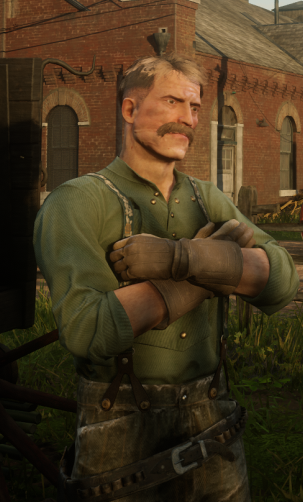
His face is unmistakable and unforgettable. Years of warfare and vigilante justice have left him covered in scars: jagged white lines over his brow, along his jaw, across his cheeks. His eyes, a deep brown bordering on black, sit behind heavy, permanent bags that speak to nights of unrest and memories that don’t sleep. His short brown-blonde hair and thick moustache frame a face that looks more like a weathered carving than living flesh.
He dresses plainly, deliberately blending into crowds. Earth-toned coats, muted greys, simple working clothes. Nothing flashy. Nothing memorable.
But the vigilante, that is different. When he takes up that identity, Hendrix dons a heavily modified version of his old U.S. Cavalry uniform. Reinforced. Stitched. Patched. Adapted for day or night, heat or cold. The iconic blue variant is the most recognized by those few living souls who claim to have glimpsed the shadowed figure before being dragged to the law.
He doesn’t smoke. He rarely drinks. His discipline is absolute. His body is honed not for vanity, but because it must be for the work he’s chosen.Early Life
Hendrix Vance entered the world on 14 September 1873 in Atlanta, Georgia. Born to parents whose names he would never know. His life began in anonymity, placed into an orphanage within days of birth, swaddled not in a family’s warmth but in the strict, holy routine of the nuns who raised him. Yet the boy flourished, or at least, thrived in mischief. Hendrix grew up loud, bright, and utterly impossible to contain. He was the ringleader of dormitory pranks, the architect of harmless chaos, and the boy most likely to charm forgiveness out of a stern sister with a smile. The other orphans became his brothers in every way that mattered; their bond was bloodless but unbreakable.
The nuns taught him scripture, discipline, and letters. He absorbed all of it, especially the Bible. Even as a child, he liked the way righteousness sounded: something clean, something simple. Something good. But purity didn’t stop him from trying to set the school toilets on fire when he was ten. That was the final straw. Hendrix and several of his closest “brothers” were carted off to an all-boys military academy, an institution designed to hammer the chaos out of children. Yet for Hendrix, the place felt less like punishment and more like a stage. He marched proudly, saluted flawlessly, and strutted through the streets in uniform with his friends, puffing their chests at civilians. The officers encouraged that patriotic pride; the boys soaked it up like sun. Hendrix excelled. Instructors loved him. His brothers rallied behind him. And when he graduated at eighteen, top of his class, he accepted an offer to join the U.S. Army’s 1st Cavalry Regiment as a Lance Corporal. Many of his childhood brothers enlisted alongside him, strengthening a bond forged by mischief and hardened by discipline.
Through his early twenties, Hendrix drifted from state to state with the regiment. It was during a posting in Texas that fate introduced him to Hannah, an alchemist travelling with "The Order of the Fallen Swallow", a wandering band devoted to studying supernatural disturbances across America. Hannah was unlike anyone he’d ever met: bright-eyed, clever, grounded in mystery, yet warm in all the ways Hendrix had once felt undeserving of. They fell in love immediately. By 1896, he proposed. She accepted. They married early the next year and spent every moment they could planning for a future big enough to swallow the world.
Then, in April 1898, duty called him to Cuba as the Spanish-American War erupted. Hendrix left behind a wife he adored, and soon after, he received a letter telling him he would return home a father. Then another letter. Twins. A blessing he could hardly wrap his mind around. He wrote letters filled with joy, fear, hope. Letters she would never read. In December 1898, before his leave could begin, a message arrived, carried not in Hannah’s hand but in that of family friend Roberto Guster.
Hannah and the twins had died in childbirth.
The world emptied. Something broke. And Hendrix, desperate not to feel the creeping void, threw himself into war with a recklessness that bordered on suicidal. He led a brutal assault on a coastal fort, turning grief into violence. It was a massacre. His men died beside him, and a shell burst almost atop him, shredding his face with burning shrapnel. Months passed in a hospital bed. He healed on the outside. Inside, something calcified. Upon discharge, he left the military without hesitation. The uniform that once symbolized pride now felt like a lie.
For four long years, he wandered across America, drifting from town to town with a Bible in his bag and a hollow ache in his chest. He never stayed long. He spoke to no one unless forced. But he watched. And when he saw wickedness, men hurting women, outlaws hurting innocents, drunkards hurting their families he intervened. Sometimes he saved lives. Sometimes he beat villains bloody. Sometimes he left men tied up in the cold with their sins on their breath. By early 1903, Hendrix stopped pretending his aimlessness wasn’t a mission. He dusted off his old uniform, tore it apart, rebuilt it into something anonymous, something righteous, something terrifying.
Present Life
His wandering eventually brought him to New Alexandria, though Hendrix didn’t intend to settle. He moved like a ghost, quiet, cautious, avoiding attachments as if they were traps laid by God to test him. But then he saw a familiar figure at a market stall. A face from another life. Roberto Guster, now calling themself Roland Cyril. The reunion was jarring, relief, pain, nostalgia, and dread all twisting together. Cyril had once been like family through Hannah. And though the memories hurt, they hurt less than the loneliness he’d been feeding on. Cyril welcomed him with the warmth of an old friend. Hendrix offered only the parts of himself that weren’t bleeding. He listened more than he spoke. He never once mentioned his vigilante life, Cyril didn’t need that burden.
Still, seeing Cyril gave Hendrix a sliver of humanity back. A place to rest his bones. A reminder that he had once been loved.
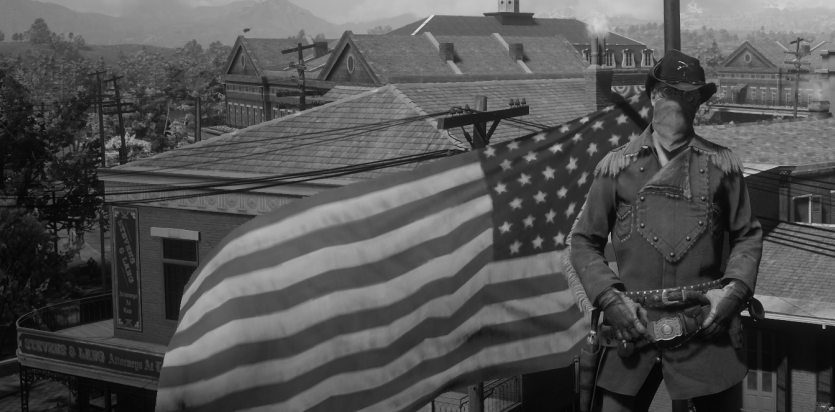
Hendrix in his vigilante costume c.1903
The Missing Year (1903-04)
Late 1903, Hendrix vanished from New Alexandria without warning.
Late one night, while tracking a gang of outlaws who had been tormenting local settlements north of the Grizzlies, just outside of state borders, he was ambushed. An organised strike clearly intended to kill him. They lured him into what looked like an abandoned lumber warehouse. The moment he entered, hidden powder charges under the floorboards detonated. The building collapsed in a roar of splintered wood and fire. Hendrix survived with broken ribs, a shattered ankle, and blood running into his eyes. The outlaws searched for his body, assuming he was dead. Hendrix waited, silent and suffocating under debris, until they rode off to celebrate.
Instead of retreating into the mountains, Hendrix pulled himself into the river, letting its freezing current carry him miles downstream. He washed up near a sparsely populated mining village, where an elderly widow found him and hid him from the gang searching nearby. Too injured to travel and too recognizable to risk discovery, Hendrix remained in her care for months, recovering in secret.
By the time he had healed enough to walk again, winter storms had swallowed the region, cutting him off from New Alexandria entirely. He spent the rest of the year surviving in obscurity, training his weakened body back to strength, waiting for the thaw.
When he finally returned to New Alexandria in late 1904, the world had moved on without him.
Most assumed the phantom vigilante was gone for good.
Some believed he died in his crusade.
Others never cared at all.
But Hendrix Vance came back silently. Colder, scarred, and more determined than ever.
Now, the uniform is back on.
And his war against wicked men continues.Affiliations
N/AQuotes
N/ATrivia
- Hendrix's vigilante outfit is a heavily modified version of the cavalry uniform he received upon graduation from Military School
- The two large scars from shrapnel that are across the right of his face still contain small fragments of the shrapnel
- He killed over 120 people during his time in the Spanish-American War
- Hendrix was almost dishonourably discharged from the army for his massacre of an assault
- He always carries a small photograph of himself and Hannah in his chest pocket
- He has an issue with a lot of Law Enforcement, believing that they do not care about the people they are meant to protect
- Out of the 14 "brothers" who joined the 1st Cavalry Regiment with Hendrix, only he survived the war
- Hendrix is very emotionally attached to horses from his time in the cavalry, treating his like they are family of his, often seen whispering to them
- He does not smoke, drink, or gamble
Hendrix Vance
Information
Status:
ALIVE
Gender:
Male
Age:
34
Height:
6"4'
Weight:
188 lbs
Birthdate:
Sep 14th 1873
Birthplace:
Atlanta, Georgia, USA
Nationality:
American
Marital Status:
Widower
Relatives:
Hannah Vance - Wife (Deceased)
Occupation:
Vigilante
Aliases:
Vance
Faction Affiliations:
N/A