

Gunther Knutts
- Views Views: 504
- Last updated Last updated:
-
Check out our Partnered Grand Theft Auto 5 Roleplaying Community New Day RP!
-
Gunther Knutts
Description
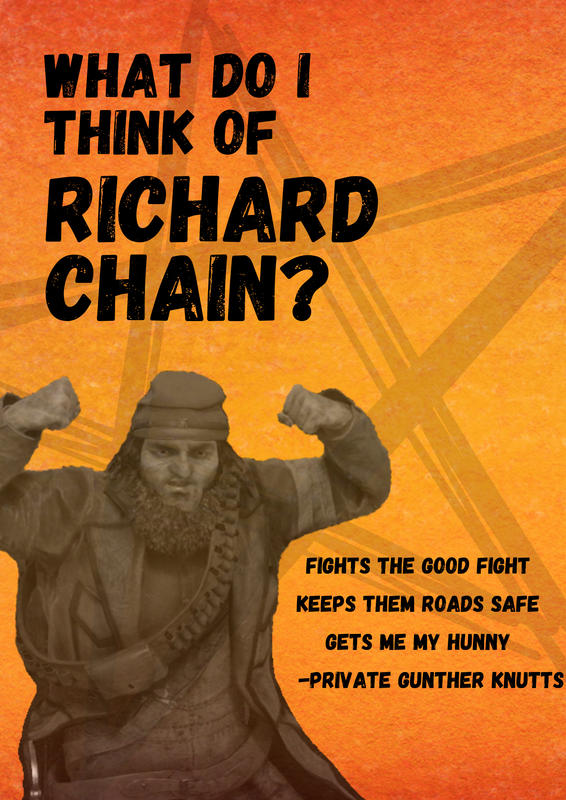
Gunther Knutts is the kind of old man people cross the street to avoid... not out of fear, but out of a quiet, unease. His true age is a mystery even to those who claim to know him best; estimates range anywhere from seventy-five to ninety, but his mind is far older, worn thin like paper left too long in the rain. Some whispered he has dementia, others say his brain simply never came back from the war. Whatever the truth, Gunther drifts through the world with the confused innocence of a child trapped inside a withering body.
He’s a small, shrunken man, stooped forward as if gravity is slowly trying to fold him into himself. His walk is a series of small, timid steps, each one governed by the grinding clank of the metal hip he earned in the war. An old piece of iron, messily put into his body that sounds like it’s rusting inside him. He cannot run, cannot hurry; the world moves past him, and he moves through it like a tired ghost.
Gunther is unmistakable to look at. His great beard is a wild, filthy tangle, thick and grey, hanging long and unwashed, and conspicuously missing a moustache, leaving his upper lip bare and sunken. What hair remains on his head clings desperately to the sides, patchy and straggled, while the top is a barren bald dome. His face is dirty in a way that seems permanent, as though the grime has settled into the wrinkles like old sediment. His nose is crooked and slightly off-center, the result of a long-ago break that was never set right, with a small, faded scar crossing the bridge like a forgotten punctuation mark.
His mouth is a graveyard, most of his teeth are long gone, leaving only a few yellow fragments jutting from his gums like broken fence posts. When he talks, his words whistle and slur around the gaps, and when he smiles, if you can call it that, the effect is unsettling.
Gunther wears his old Confederate uniform as though it were his skin. The wool is frayed, faded, and stiff with age, smelling faintly of mildew and gun oil. A bright yellow armband encircles his sleeve, the mark of The Old Timers, the ragtag “veteran brotherhood” he devotes himself to with blind, unshakable loyalty. He follows their commander, Lieutenant Colonel Richard Chain, with absolute obedience. Chain gives orders; Gunther repeats them. Chain points; Gunther marches. Without Chain, Gunther wouldn’t know where to stand, when to speak, or who he is supposed to be.
There is no independent thought behind his sunken eyes. No opinions. No ambitions. His personality is a hollow room waiting to be filled by whoever shouts loudest.
Early Life
What scraps remain of Gunther Knutts’ real life exist only as disjointed echoes buried deep beneath decades of manipulation. Even he does not know the reality of who he is...
In truth, he was born in New York City under the name Bartholomew Alexander Eugene III, heir to a line of British loyalists who had quietly remained in America after the Revolution. His father, Bartholomew Alexander Eugene II, and mother, Lady Eleanor Harrow-Eugene, maintained their aristocratic airs within a great old mansion, clinging to the last, fading embers of British nobility.
Bartholomew grew up surrounded by books, fine tapestries, and the ghost of an empire his parents still toasted. He was raised in a strict British manner; formal posture, immaculate diction, and mandatory cultural immersion. This upbringing earned him relentless bullying at school, where his schoolmates mocked his clipped accent and polished manners. But beneath the prim exterior, little Bartholomew was quietly fascinated by the American Revolution, by the tale of a people who defied the very crown his parents revered. He hid his admiration carefully, devouring stories of Continental heroes in dim corners of the mansion.
His interest turned toward the military, driving him to enroll in an officers academy. His parents approved, comforted by the belief that an officer was noble regardless of which flag he served, though they secretly hoped he’d one day restore the family’s loyalty to Britain. Bartholomew excelled. Intelligent, steady-handed, and well-read, he rose as a respectable Union officer by the time the Civil War ignited, earning the rank of Captain. His parents begged him to ride south and join the Confederacy, “the closest thing left to civilized order”, but he refused. His loyalty was to the United States.
During one particularly chaotic battle, Bartholomew led a bayonet charge through thick musket smoke. In the confusion, he became separated from his men. Running blind through the fog, he collided with a Confederate private who cracked him across the face with the butt of his musket, breaking Bartholomew’s nose and sending him tumbling unconscious into the mud.
A Confederate officer later found his limp, bloodied body among the dead and dragged him to a nearby prison camp. When Bartholomew awoke days later, he was no longer himself. The blow had done more than break bone, it had shattered his mind.
He wailed, thrashed, cried out for names he couldn’t remember. He couldn’t state where he was, who he was, or even what a war was. The guards reported his erratic behavior to their superiors.
Major Charles Luckley, the vicious overseer of the camp, saw opportunity.
At first, Luckley tested him like one would a confused dog, waving jars of honey or slices of bread just outside the bars, conditioning him to repeat whatever phrases Luckley spoke in exchange for treats. Within weeks, Bartholomew’s broken mind became clay, soft, yielding, and eager to please.
What happened next reshaped him forever.
THE CONFEDERATE LIE
The story the Confederates fed him was not just false, it was cartoonishly propagandised, crafted with the emotional subtlety of a circus poster and the political nuance of a sermon delivered by a man frothing at the mouth.
In this invented history:
He was Gunther Knutts, born in the blessed, God-touched soil of Alabama, where the air was “thicker with liberty than Yankee lungs could bear.” His parents, Samuel Knutts, a humble yet wise Southern patriarch, and Martha Mae Knutts, the gentle Catholic saint of their homestead, raised him in a paradise of church bells, sweet tea, hymnals, and unquestionable moral purity.
He “remembered” learning scripture on his mama’s lap, chopping firewood with his papa, and being taught that the South was the final bastion of American righteousness.
He also “remembered” the Yankee tyranny, exaggerated to mythic extremes. According to the Confederates, the Northern Government drafted him at sixteen, “dragging innocent boys from their warm beds to serve their filthy imperialist machine.” They painted the Union Army as a hive of cruelty where officers beat him, starved him, and mocked his faith.
And then came the heroic twist, the part Major Luckley loved to recite with theatrical flourish:
"Gunther, the noble, simple son of Alabama, defected. He cast off the chains of Northern oppression and ran to the arms of the Confederacy - the true saviors of American liberty.”
In their tale, he fought bravely, bayonet in hand, standing tall in a sea of saints against the “Northern hordes.” During one impossibly heroic stand, he was captured, after killing dozens, of course, and then “brutally beaten” by Union monsters who broke his nose and shattered his leg. Why they then “mercifully” gave him a metal replacement was chalked up to “Yankee confusion... Proof they ain’t right in the head.”
It was preposterous, propagandistic, and shamelessly self-congratulatory.
And poor Gunther believed every word.
THE WANDERING YEARS
When the war ended, Gunther drifted into the American interior with nothing but his Confederate uniform. It was too large, mismatched, and stitched wrong in places. The fake memories still rattled inside his fractured skull. He wandered from state to state like a misplaced relic, clinging to his false identity and craving honey with a childlike desperation.
People learned quickly how easily he could be controlled.
In Kansas, a group of bandits discovered his weakness. They held out a jar of apple honey and told him to keep watch during a robbery. Gunther, eager to make new “friends,” did as told. When the sheriff arrived, the bandits shoved the stolen goods into his arms and fled. Gunther tried to explain that he was “doing a brave Southern duty,” but the sheriff only beat him, spat on his uniform, and left him bleeding in the road.
Years later in Tennessee, a group of roughneck brothers convinced Gunther he was their “elite war hero.” They propped him outside a saloon as their enforcer. When a brawl broke out, they threw him into the fray to take the first fists. While he lay dazed on the floor, they emptied the cash drawer and disappeared.
In Missouri, a travelling preacher told Gunther that heaven was a land of milk and endless honeyjars, and that salvation could be bought for just a few coins. Gunther handed over everything he had.
Town after town, year after year, people used him, lied to him, beat him, abandoned him. But Gunther never blamed them. In his mind, he was helping. And that was all he wanted to do.
By 1903, worn down, barefoot, and sunburnt, with his uniform hanging off him like a mourning shroud, Gunther limped his way into New Alexandria.
He had nowhere left to wander.
But he still needed someone to follow.
Someone who would tell him who to be next.
Present Life
Gunther Knutts’ arrival in New Alexandria around the turn of the century coincided with a loneliness he could never name. He wandered the town post office one morning, aimlessly scanning the notice board, when a small, weathered advertisement caught his eye:
“THE OLD TIMERS - A fraternal association for CIVIL WAR VETERANS. Weekly meetings. All uniforms welcome. Comradery. Brotherhood.”
The wording seized him. Veterans. Uniforms.
He copied the address with shaking hands and soon contacted the association’s head, Lieutenant Colonel Richard Chain. When the two finally met, Chain flanked by a few grizzled men who claimed their own wartime credentials, Gunther felt an immediate, overwhelming attachment. He was a fairly muscular man, with an aura that commanded respect and authority. And he spoke with the assurance of an officer and the confidence of a man used to leading. Gunther introduced himself with pride as Private Gunther Knutts, Confederate soldier, survivor of valiant battles that never truly existed.
Chain listened with polite nods, a faint smirk, and a strange glimmer of curiosity in his eyes. Gunther didn’t notice. He had found a place. Attachment to Chain came instinctively to Gunther, almost painfully so.
OLD TIMER TUESDAY
The Old Timers met every Tuesday, and Gunther never missed a single one. That was why, on the day a small group of actual Union veterans innocently arrived to join the gathering, Gunther reacted like a cornered animal. The moment he saw their blue coats, his body froze, then shook. He bolted, hobbling as fast as his metal-supported leg allowedh shouting half-formed battle cries from a war he remembered wrong.
In a panic, he stole a farmer’s wagon outside the meeting hall, spurring the horse down the road as deputies shouted after him. The chase was short. His leg made him slow, his panic made him sloppy. He was seized, tried, and sent to Sisika Penitentiary for a few months on charges of horse theft.
Gunther wept in his cell, believing he had disgraced the Old Timers already.
While imprisoned, he received a letter from Chain. The Lieutenant Colonel’s handwriting was disciplined and sharp:
"Private Knutts
You need to understand that the Old Timers is an association for all Civil War veterans, blue and grey alike. You can’t go running every time you see a Union coat, those days are long gone. When you’re released, we’re riding up to Big Valley with a few Yankee boys, and I expect you to conduct yourself like the rank you are, Private. Suck it up, remember we are all veterans of the same war.
- Lt. Col. Richard Chain"
Gunther, desperate to regain Chain’s approval, obeyed the words as if they had been carved into stone.
AFTER SISIKA
After his release, Gunther joined the arranged expedition. The Union boys were friendly in a rough, teasing way, constantly poking fun at his low “rank” and his unwavering Confederate pride. Gunther bristled, snapping back with crude insults, only to immediately turn and apologize profusely to Chain, bowing his head like a reprimanded child. Chain accepted every apology with a tired sigh.
When they reached Big Valley, Chain revealed the group’s true purpose: The Old Timers were not merely a veterans club, they were a volunteer patrol. They used their old military skills to protect travelers, ranchers, and traders from dangerous wildlife. Chain wanted their presence to bring stability and safety to the frontier.
Gunther practically saluted at the idea. A mission. A cause. Something to fight again.
The hunts began. And soon, resentment grew. The native communities of Big Valley accused the Old Timers of slaughtering wildlife they had no right to touch. They said they had never asked for protection, never asked for soldiers roaming their hunting grounds.
Tension escalated. When the Old Timers patrolled, the natives shadowed them silently from the tree line. Sometimes intervening. Sometimes sabotaging traps. Sometimes simply watching. Gunther muttered about enemies in the brush. Chain warned him not to escalate.
It was a simmering conflict, one that only needed a spark.
THE SPARK
After Chain publicly announced his candidacy for Governor of New Alexandria, that spark struck. The locals launched a coordinated complaint to lawmen across the state, accusing the Old Timers of:
- Impersonating military officials to intimidate townsfolk.
- Harboring Confederate loyalists who still pledged allegiance to a treasonous Government.
Gunther, in his naïveté, had frequently told townsfolk that he still “served the Confederacy” and that the war was “not over in his heart.” His stories, fully believed, entirely imaginary, gave lawmen all they needed. They swept through the region and arrested every Old Timer, including Chain.
The trial took nearly an entire year due to various complexities. Gunther, terrified and confused, believed the entire ordeal was a malicious conspiracy designed to stop the obviously righteous Chain from winning the governorship, because in Gunther’s mind, Chain would have won in a landslide.
However, Richard Chain proved to be as well-read and clever as he was rugged. In court, he dismantled the charges piece by piece:
- They never used military ranks beyond friendly banter.
- Their uniforms were not accurate attire for either side, so could not be mistaken as real uniforms of either former army
- The Confederate members spoke fondly of their past just as the Union men did - nostalgia, not sedition.
- None had taken oaths, issued commands, collected pay, or exercised authority.
Gunther took the failure harder than anyone. Though Chain never blamed him, not even once, Gunther was consumed with shame. He believed he had disgraced his commanding officer, sabotaged the campaign, and dishonored his Old Timer brothers.
He fled into the Bayou, hiding among the swamps for nearly a full year, surviving on alligator meat and whatever else he could forage. He spoke to no one.
In 1904, exhausted, ragged, and driven by a desperate need to make amends, Gunther Knutts finally had the urge to make a decision by himself...
He emerged from the marshes with a single objective:
Find Colonel Chain and serve him once more... As Private Gunther Knutts, THE OLD TIMER!
Affiliations
United States Army (FORMER)
THE OLD TIMERS (ACTIVE)Quotes
- "You have any honey?"
- "YES LOOTENANT KERNEL CHAIN!"
- "Dat's mah hips"
- "God save The Old Timers!"
- "MAH NAME IS PRIVATE GUNTHER KNUTTS, 12TH ALABAMA INFANTRY REGIMENT, CONFEDERATE STATES ARMY, YEE-YEE"
Trivia
- As previously shown, Gunther was not a Confederate. He was not a Private. He was not even Gunther. But now, to him, he truly believes everything.
- Gunther LOVES honey. Wave some honey infront of him, and he will do whatever you tell him to.
- He was once a poster boy for Richard Chain during his Governorship bid.
- There was a time when he had a deal with a Deputy in Valentine in which Gunther agreed never to steal another wagon in return for weekly jars of honey. And when that Deputy failed to keep up with the deal on just a single day, Gunther stole 10 wagons.
- Knutts holds Richard Chain's life above his own... Like seriously, it's concerning.
Private Gunther Knutts
Information
Status:
ALIVE
Gender:
Male
Age:
Unknown
Height:
Unknown
Weight:
Unknown
Birthdate:
Unknown
Birthplace:
Unknown
Nationality:
American
Marital Status:
Unknown
Relatives:
Unknown
Occupation:
Old Timer
Aliases:
Private Honey
Faction Affiliations:
US Army (FORMER), The Old Timers (ACTIVE)